




How to Edit and Proofread Your Thesis: A Complete Guide
Editing and proofreading a thesis or dissertation means checking the manuscript for structure, language, formatting, and citation accuracy before it goes to your supervisor or committee.
The process begins with assessing whether your ideas progress logically and your writing follows your program's required style and referencing conventions. Afterward, you will check whether grammar, clarity or phrasing issues need to be cleaned up before submission. Finally, small issues (e.g., misplaced commas) are corrected.
Style and formatting guidelines to confirm before editing
It can be easy to dive right into writing your thesis. That said, you’ll save yourself a lot of time and aggravation if you follow all necessary guidelines from the start. These are usually university, department, or field- or journal-specific requirements and include the following:
- Referencing style (e.g., APA, AMA, IEEE, MLA, or a university- or journal-specific style)
- Format (i.e., headings, font, page layout, file type—your school’s graduate studies office is likely to have a template)
- English variant:
- In English-speaking locations, this is generally the local variant
- Elsewhere, look through your university’s thesis/dissertation guidelines or ask your supervisor
- Type, such as monograph or integrated article
English writing can be nuanced at times and downright confusing at others. We use (and recommend) The Chicago Manual of Style as a comprehensive guide.
How to edit and proofread your thesis: Key steps to follow
Once you have finished a draft and applied the appropriate style, you can begin the thesis editing and proofreading process. Your thesis will require more time than you might anticipate and there are a number of issues to consider:
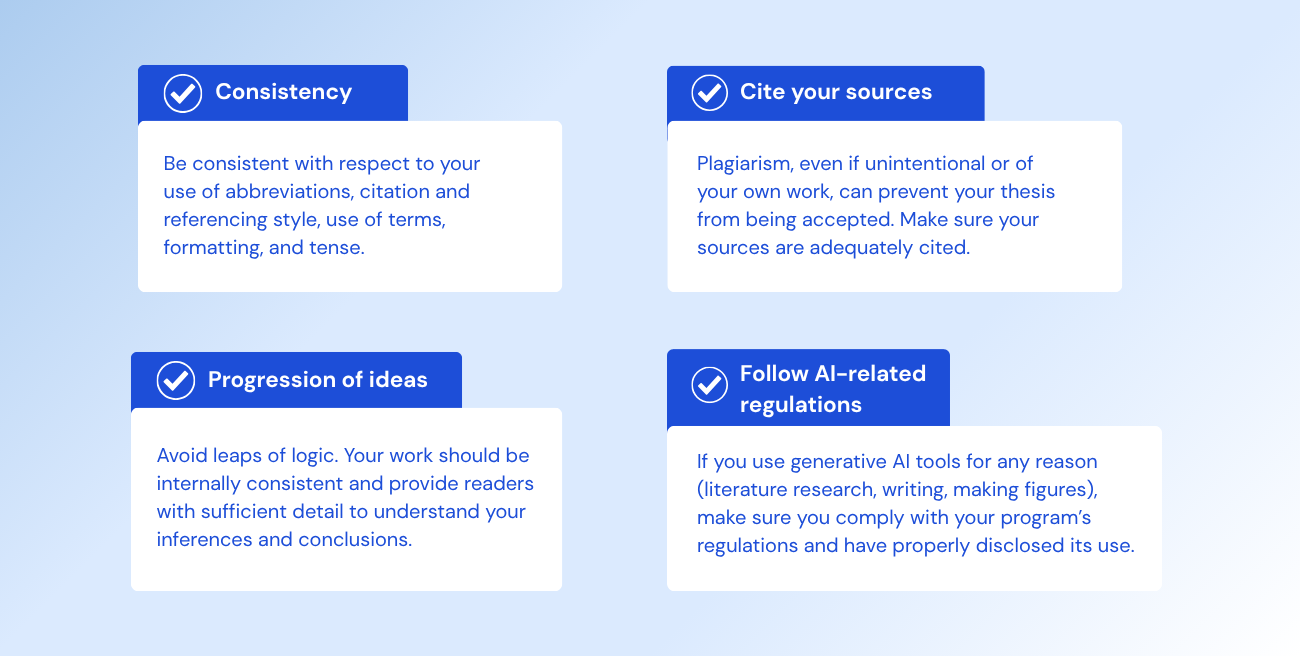
Remember that AI can produce incorrect output with what seems like great confidence—you’re ultimately responsible for verifying it.
Editing a thesis is a multi-step process that begins with the review of the first draft and ends when you integrate your thesis committee’s suggestions and required changes into the final version.
A step-by-step approach to self-editing your draft
Many issues can be caught and corrected in a careful, thorough self-edit. Before sending your thesis to an external editor or your committee, it’s worth doing a few passes instead of trying to catch everything at once.
One way to edit your own work is to follow these steps:
- Structural read: Read through for argument and organization first (and try to ignore grammar and formatting). Does each part follow logically from the last? Does the evidence you've presented support your conclusions?
- Language pass: Reread for clarity and tone. Look for long sentences, repetitive phrasing, and technical terms that aren't defined when they’re first used.
- Formatting and citation check: Confirm that your headings, page layout, and file type match your required template. Check that every citation follows your required referencing style consistently and that all citations have a matching reference (and vice versa).
- Final proofread: Make one last pass for typos, spelling, and punctuation, ideally after stepping away from the document for a day or two.
That said, you look at your own work constantly. Errors and other issues can fade into the background, making it beneficial to have an external editor review your draft and provide commentary. In addition to fixing grammar, formatting, and referencing issues, our editors can give general advice about your logic and argumentation. We can find the issues that you miss and keep them from slowing you and your work down.
Ready to get started?
Learn more about our Thesis, Dissertation, and Proposal Editing service and request a quote.
Right now, thesis and dissertation editing is 15% off as part of our Back to School 2026 offer. Use code BACK2SCHOOL26 through October 6.