


Before you submit — or pay for a full edit
Find out if your research story holds together
Built on a structural framework developed by Scribendi's research editors, the assessment shows where your paper's story breaks and what to fix first.
The dilemma
Research is complex. Does your paper convey a cohesive narrative?
A narrative can break in more than one place. Maybe the contribution is buried, the claim never gets the evidence it needs, or the conclusion doesn't deliver what the opening promised.
A full edit is a real commitment, and a language edit won't fix a structural problem. This assessment tells you what your paper needs before you spend time on the wrong thing.
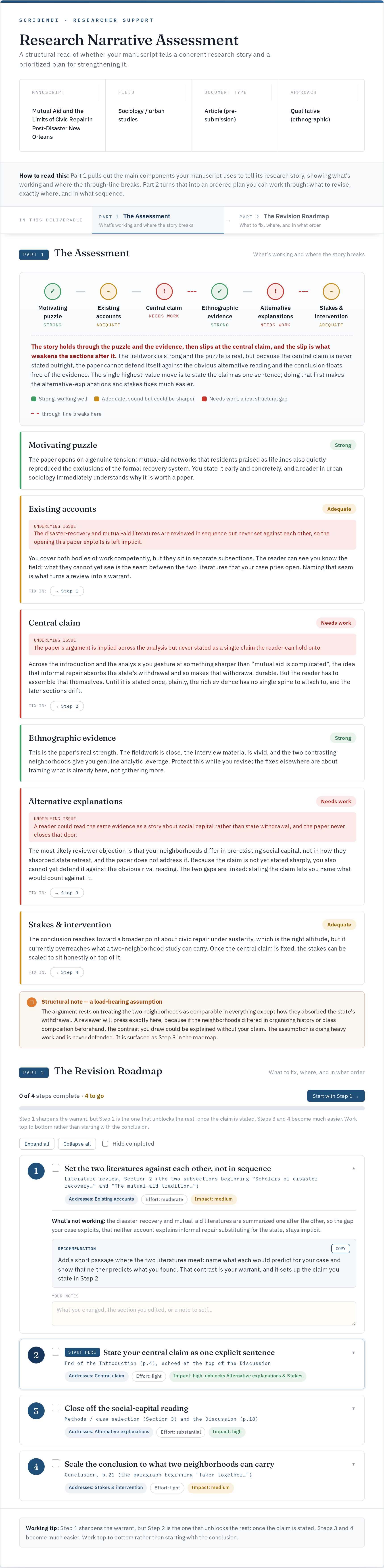
The sample assessment shown is for demonstration only.
What it does
It reads your paper the way reviewers will
The same five functions are assessed for every paper. What changes is where your paper performs each one, what your field calls it, and how well it carries the weight your argument puts on it. The mapping and judgment of these functions in your paper is the assessment.
The five functions in your paper
Every research story, in any field, has to do five things to hold together:
- Motivate the work
- State a claim
- Ground the claim in evidence
- Explain what the research contributes
- Deliver what the opening promised
The assessment works through all five, naming where your paper performs each using your own terms and determing how well they fulfill their purpose.
How they hold together
Each function is rated strong, adequate, or needs work and is placed on a line in the order your argument flows.
Where the through-line breaks, the line is drawn broken. A function your paper never really performs stays on the line, rated needs work, with a note on what is missing and why it matters.
A prioritized plan to fix any breaks
The roadmap turns the diagnosis into numbered steps, each naming:
- What is wrong
- Where in the paper the issue lies
- What needs to be done to resolve it
They are ordered by impact and dependency rather than page order, so the fix that unblocks everything else comes first, and each is tagged with the level of effort.
See the sample assessment above for a full example of both parts.
What you receive
A clear read of your argument, and a plan
One page in two parts: the assessment, then the revision roadmap. Built to be an interactive workflow tool, not just a document to be read.
- All five functions of your argument, each rated strong, adequate, or needs work, with the sections of your paper that carry them named in your own terms
- A narrative through-line showing how the five connect, with the line drawn broken where the argument slips
- A clear indication when your paper does not fulfill one of the five: an unstated contribution, a claim without grounds, a conclusion that doesn't land
- A note on any load-bearing assumptions your argument rests on but never defends
- A prioritized revision roadmap: numbered steps naming what to fix, where, and in what order, each tagged with effort and impact
- A working page where you can check the steps off as you revise, with your progress and notes saved between sessions
How it works
Three steps to a clear diagnosis
Send your draft
Upload your full manuscript, at whatever stage it's at. No prep needed.
Your draft is assessed
Your paper is read against all five functions by a Scribendi AI tool, built in-house by research and language experts, that applies a structural framework developed from years of working with manuscripts at different stages.
You decide what's next
You see where your paper stands, so you know what to do next. If the research narrative holds, an edit is the next step. If it doesn't, the roadmap tells you what to revise first, and our Humanities, Scientific, Academic, and Custom Science services can help you do it.
What comes after
Spend on what your paper really needs
The assessment points you to the next step, so you don't jump into editing and proofreading when the argument still needs work or further research engagement.
If your story holds
Academic Editing
Every function is present and pulling its weight, and what's left is the writing.
An editor works on clarity, organization, style, and tone, flags any remaining problem areas, and returns your paper with tracked changes and a summary of the major edits. The foundation is solid; this service ensures it reads that way.
If the argument needs a specialist
Scientific Editing or Humanities & Social Sciences Editing
A subject-matter editor in your field evaluates the argument, the evidence, and how the research is presented, and an English-language editor ensures the prose is publication-ready.
Best when the structure mostly holds, but the claims, evidence, or framing need someone who knows the field to weigh in.
If the research itself needs developing
Custom Support for Researchers
Sometimes the problem isn't on the page: a contribution that hasn't been settled on, or a claim the research can't yet support.
This service works with you across the stages of developing the research and preparing it for publication, scoped to your project rather than a single pass over a draft. The cost of the assessment is put towards the price of this service.
Pricing
One flat price. No commitment.
Research Narrative Assessment
Flat rate · AI-delivered · assessment and revision roadmap
- All five functions rated and mapped to the sections of your paper that carry each
- Notes on where your argument holds, where it breaks, and what's missing
- A narrative through-line, plus a note on any undefended assumptions
- A prioritized revision roadmap you can work through and check off
A diagnosis, not a guess
You get a structured read of your actual argument, not a vague "looks good." It is a specific, function by function, check against the five things every research story has to do.
Built by research editors, for researchers
The assessment is delivered by AI. What it applies is a framework built by Scribendi's research editors, the people who spend their days working out why a paper's argument does or doesn't hold, so what reaches you is their reading of structure rather than a generic critique.
Spend wisely
For $50 you find out what your paper needs before committing to a bigger service. No more buying the wrong kind of help.
Built for big arguments
Particularly useful for complex, multi-part papers that make several claims at once, where the real risk is that they never add up to a single contribution. The assessment is built to catch exactly that: whether one contribution ties your claims together or the paper reads as multiple, disconnected arguments.
Know what your paper needs
For $50, find out how your research story holds together and where it needs strengthening before you submit.
Check my paper