



Ensuring High-Quality Feedback: Scribendi's Editor Engagement Project
Ensuring High Quality Feedback: Scribendi's Editor Engagement Project
Summary
- Human editors can use commentary to provide the critical feedback that AI can't.
- To ensure that our editors are consistently offering engaged, detailed commentary, Scribendi has launched its editor engagement project.
- Editorial Manager Bryan Russell shares his thoughts on the project and how human editors can make all the difference for a text.
Using AI to edit your work can seem tempting. AI can spot and correct outright errors very quickly, and it can respond flexibly to a variety of prompts.
However, it also comes with certain risks. AI cannot truly think critically about your document; as a result, it might erase your writing style, delete necessary content, introduce plagiarized material, or adjust text in a way that does not align with your intended meaning or context.
A human editor thus offers an enormous benefit: the ability to engage deeply and thoroughly with your writing, avoiding the above risks and making improvements that go beyond mere error correction. One of the main ways in which this advantage is expressed is commentary.
As a human editor goes through your work, they should provide valuable feedback that helps you address logical gaps, align your writing with specific conventions, and clean up structure and flow, among many things. Crucially, critical commentary can also highlight instances in which the meaning is unclear, providing you with alternative options rather than simply changing your work in a possibly incorrect way.
At Scribendi, we are always trying to improve our craft, and we recognize that it is more important than ever for our editors to show the true value of human editing through in-depth, engaged feedback. We believe that this feedback is a major part of what we call the Scribendi difference—the high-quality editing that can only be provided by an expert human editor.
The Editor Engagement Project
Accordingly, Scribendi has introduced our editor engagement project, which involves regularly assessing our editors' work to ensure they are providing the best possible commentary. Overseeing over 200 editors, we recognize that it's essential to provide a consistent level of engagement that leaves clients sure that they can trust Scribendi to truly elevate their writing.
Spearheading the project is Scribendi's Senior Editorial Manager, Bryan Russell, who works closely with our editors to ensure that we are constantly improving our service. As a writer himself, he understands firsthand the value of expert feedback and critical engagement.
Interview with Bryan Russell, Senior Editorial Manager
How does Scribendi assess the quality of an editor's engagement?
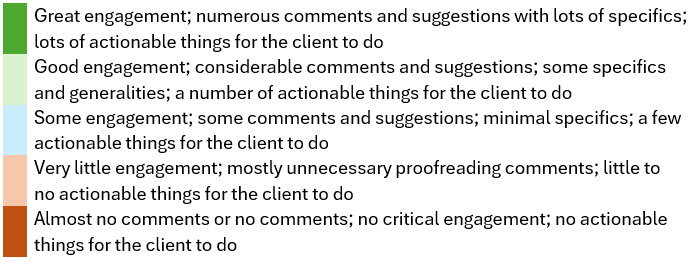
Each month, we review a comprehensive sample of our editors' work. We always expect great revisions from a language standpoint (and we have long had an in-depth evaluation process for the technical elements of editing), so our engagement evaluations look deeper than the surface skin of sentences: We look at the level of support provided to writers via critical commentary. It's not just about error correction and solving the riddles of language—this is only the starting point. At the finish line, we need to know that our critical engagement has helped our clients push their work to the next level … and the level after that.
In evaluating this engagement, we carefully review every comment. The feedback resulting from these evaluations is a key element in continual improvement. Greatness is not static but elastic, a daily evolution that results from focused attention on growth and the adaptation to new work and the needs of new clients.
Why is it so important to perform these evaluations?
We do these evaluations because we believe greatness is possible in every piece of writing, and we believe that we can help authors achieve this. Are our editors going above and beyond to help authors improve their writing? We don't want to simply hope that our editors are doing this. So, we push improvement and then confirm that this improvement has been realized. This is why we can guarantee the best support for our clients.
If an editor does not help an author push for greatness, they will not work for Scribendi. For us, it's about the vital relationship between an author and an editor. As editors, we need to step up as partners in the writing process: We need to be just as dedicated as our clients to the quality of their work and to improving every aspect. If it is meaningful for our clients, it must be meaningful for us. In this age of increasing disconnection and misguided AI use, where patterns have come to replace the personal, human insight and engagement are the most vital aspects in pushing growth and creating new meaning in creative work like writing.
You emphasize critical commentary, and not just commentary in general. What transforms an ordinary comment into an extraordinary one?
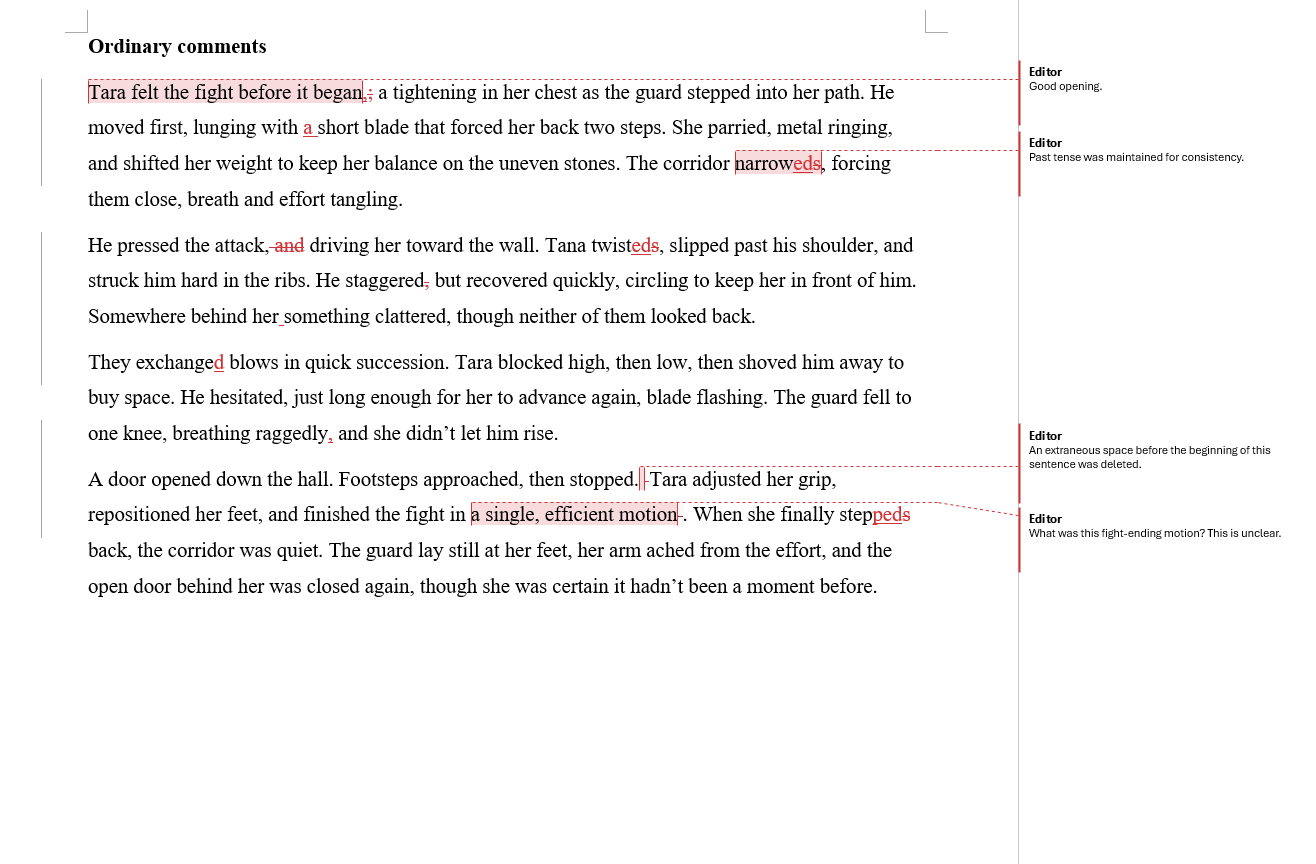
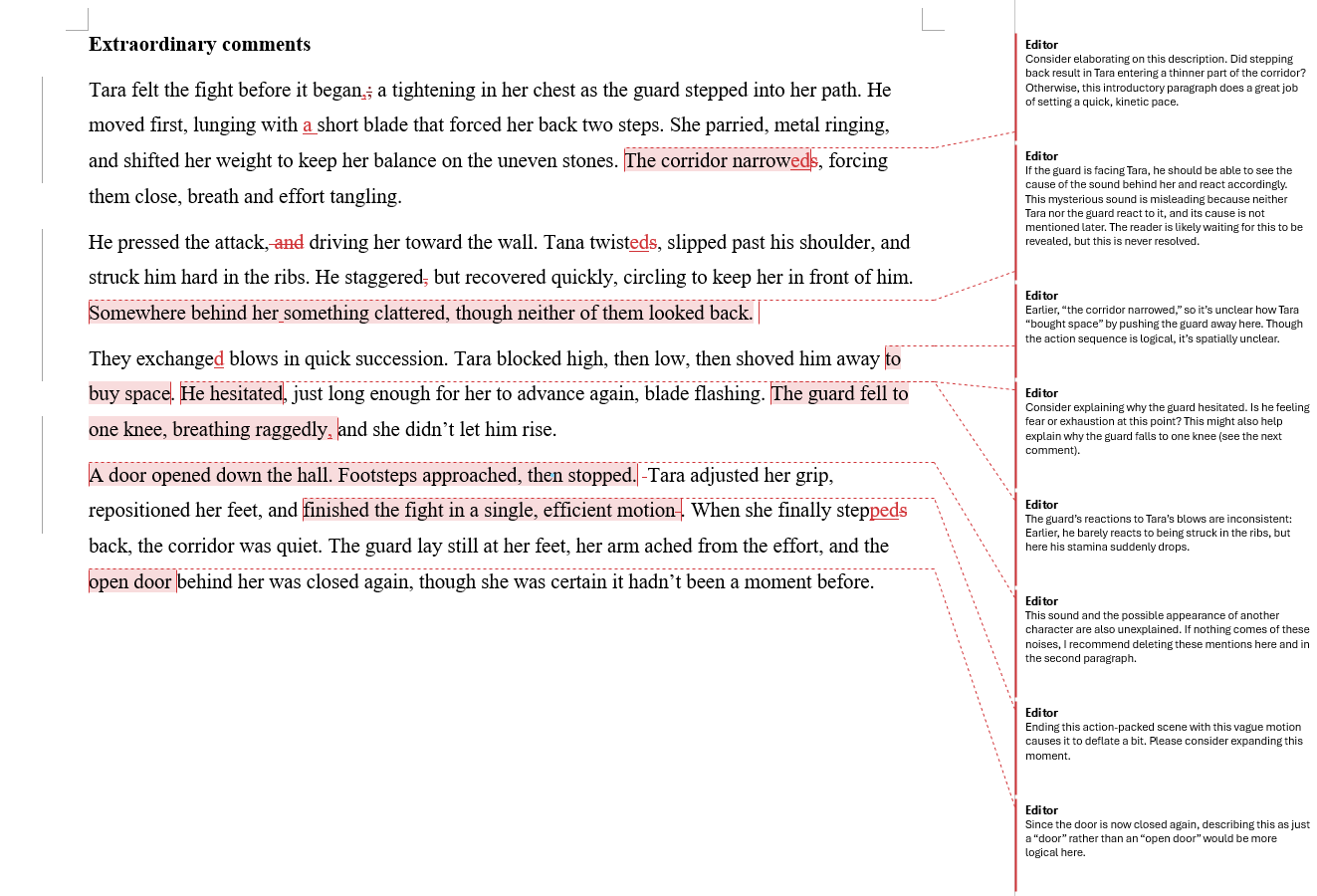
An ordinary comment typically points out some minor issue (and such identifications are important because these issues need solutions if the work is to be effective), but extraordinary comments tend to go beyond this and help authors to see their work in a new light. These comments make concrete the potential benefits of these possibilities and provide guidance in how the author can explore them. A good comment helps to identify a problem or concern, while a great comment moves the work forward and helps the author develop it.
How are Scribendi's editors responding to their evaluations?
Our editors are always up for a challenge. They are not only perfectionists committed to the mastery of language but also engaged professionals who care deeply about helping others. Responsibility and a growth mindset are prerequisites for working at Scribendi: Editors must embrace the necessity of meeting the highest standards. We focus on developing flexible editors who can engage on multiple levels, understand the context and aims of the work at hand, and help the author push it forward. Scribendi's editors understand that each new order is an opportunity for growth: for the document, for the author, and for the editor.
Since context matters, what happens if a work is already well-written? Are there still the same opportunities for critical engagement?
We feel there are always spaces where every work can be improved. Strong writers want critical feedback just as much as writers who may struggle more with writing. Often, one of the reasons that such great writers are great is because they value, seek out, and implement feedback. This is a vital part of the process in the development of not only a written work but a writer. It's a bit like the experimental process: An author has an idea, develops and seeks to answer questions, considers different variables and factors, and then collects and analyzes data (with the help of feedback) to form the most appropriate conclusions. Editors play a key role in the analysis process, helping the author to understand their literary aims, questions, variables, and data in the clearest light, offering suggestions and insight to guide the author in the next iteration of their document: the final draft. While some early drafts require more work than others, critical engagement is always a necessity to help find and close gaps in the work. The gaps may be smaller and the insights more subtle in some works, but such subtle gains are often the difference between good writing and great writing.
What, in your view, is the Scribendi difference?
I think it's Scribendi's commitment to supporting authors and helping them to develop all aspects of their work, from the smallest comma to the overarching structure. Writers want their work to be the best it can be, and Scribendi shares this goal. We're committed to improving everything we work on, and we feel true growth comes from critical engagement and the best of human insight. While advances in technology can support existing talent, it is human attachment and critical engagement that provide the real difference.
See the Scribendi difference:
Experience deeply engaged editing
and insightful commentary
Related Posts

10 Reasons to Hire a Professional Editor
Good writing comes from good editing. A professional editor does more than correct mistakes; they can help you turn lead into gold! The following are 10 reasons to hire a professional editor.
Editing and Proofreading Tips for Bloggers
These editing and proofreading tips for bloggers will help the you optimize your posts and get the most out of your online publications.